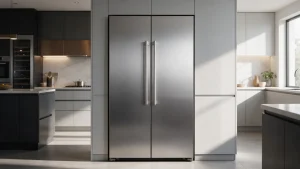
Refrigerators
This reference helps organize useful information before refrigerator service.

Specialized Fisher & Paykel Appliance Repair in San Francisco
Mon–Sat: 8:00 AM – 7:00 PM
Refrigerator · in-home diagnosis
A refrigerator complaint is most useful when it is described as an operating condition rather than a guessed failed part. Record the complete model or product code, when the behavior begins, whether it is repeatable, and any message shown on the control panel before settings are cleared.
For refrigerator service, especially useful observations include actual compartment temperatures, frost pattern, door seal behavior, water/ice operation, and noise. Those details help separate installation, supply, control, mechanical, airflow, water-flow, temperature, or heating paths that can produce similar symptoms. A defrost cycle, in which the cooling system periodically warms to clear frost, can explain a temperature that rises at regular intervals, so the timing of a rise is as useful as its size.
These observations describe what the appliance is doing; they do not identify a replacement part by themselves. Fisher & Paykel product families span multiple generations, and the exact model determines which systems, sensors, and fault logic are present.
Owner checks should remain external and reversible. Confirm normal user settings, visible obstructions, doors or drawers closing freely, accessible filters where the user guide permits cleaning, and household supply conditions that can be checked without disassembly. The door seal, or gasket, should meet the cabinet evenly all the way around, and a visible gap or folded section is worth noting.
Do not remove protected panels, probe live wiring, adjust gas components, bypass interlocks, open sealed refrigeration systems, or enter technician-only procedures. Preserving the original symptom and display information is usually more useful than repeatedly resetting the appliance.
Stop normal operation if there is smoke, a burning odor, visible arcing, repeated breaker trips, uncontrolled heating, active water reaching electrical parts, a gas odor, or severe mechanical movement. Address the immediate safety condition instead of trying to reproduce the fault.
Fisher & Paykel may use the same broad product name across several platforms. Controls, sensors, heating systems, pumps, fans, valves, communications, and error-code meanings can change by generation and market variant.
Use the model directory with the full identifier from the rating label. If the exact model is not listed, include the complete code with the service request rather than selecting a visually similar appliance.
Use the error-code library only when the code record matches the appliance family and model or platform context. Short labels can be reused on different Fisher & Paykel products, so the appliance identity belongs with the code.
A code is diagnostic evidence, not a parts order. If it returns after an owner-safe check, preserve the display and operating stage for the appointment. Fresh-food and freezer sections are cooled and monitored separately on many refrigerators, so naming the affected section helps start the diagnosis in the right place.
Access conditions vary sharply across San Francisco. Share gate or building-entry instructions, stair count, elevator availability, and any cabinetry that limits service clearance around the appliance.
Built-in appliances also depend on clearances, ventilation, drain routing, water supply, electrical connection, and cabinet alignment. A symptom that started after remodeling or moving the appliance is worth calling out explicitly.
No. It identifies a diagnostic direction. Exact-model testing and installation context are needed before a component is selected.
Record it first. A normal user-level reset may be appropriate for some models, but a recurring code is more useful when the exact message and operating stage are preserved.
Not as a default. Similar Fisher & Paykel appliances can use different controls, components, and service logic, so the complete model/product code should guide the repair path.
Mention stairs, elevators, garage or loading access, building-entry procedures, tight cabinetry, and anything that could affect safe access to the appliance.
Send the full model/product code, the symptom, any displayed message, and the relevant access details so the service request starts with useful evidence.
This reference helps organize useful information before refrigerator service.
Code 1 means the power module failed its self-test on the last power-up. This is a service-level fault.
Code 10 means the fresh food (PC) sensor resistance is below the normal range of 660 ohms.
Code 11 means the current for the ambient heater and both fans reads lower than expected.
Code 12 means the combined current for the ambient heater and both fans is higher than expected.
Code 13 means the low ambient heater draws less current than expected, from an open circuit or a faulty heater.
Code 14 means the low ambient heater is drawing more current than expected, from a short or a faulty heater.
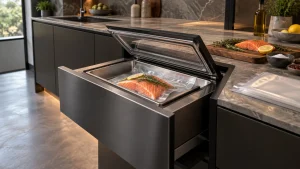
A vacuum seal drawer complaint is most useful when it is described as an operating condition rather than a guessed failed part.
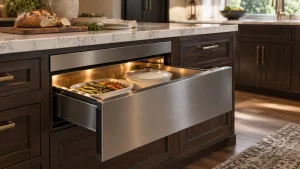
A warming drawer complaint is most useful when it is described as an operating condition rather than a guessed failed part.
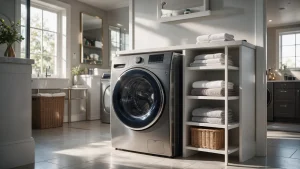
A washer complaint is most useful when it is described as an operating condition rather than a guessed failed part.
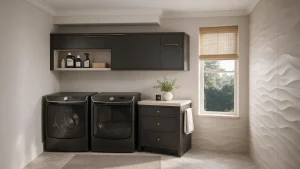
A washer-dryer complaint is most useful when it is described as an operating condition rather than a guessed failed part.
Share a few details and we’ll confirm an appointment. Prefer to talk? Call us and we’ll help right away.