

Specialized Fisher & Paykel Appliance Repair in San Francisco
Mon–Sat: 8:00 AM – 7:00 PM
A Fisher & Paykel oven that bakes unevenly usually has a rack, tray or function cause. Map the pattern with a one-tray test first.
Written for Fisher & Paykel owners
Uneven baking from a Fisher & Paykel oven has a cause that is most often rack position, crowded trays or the wrong function, and less often a failed element or fan. Bake one tray in the middle position with generous space around it, rotate it once, and see where the pale or dark areas fall before suspecting the oven.
Uneven baking has a shape, and the shape is the clue. Bake a tray of evenly spaced biscuits or a sheet of plain bread slices and note where they brown. If the back always cooks faster than the front, or the left side runs darker than the right, heat distribution is lopsided. If the top browns while the bottom stays pale, the issue is vertical, such as rack height or the function chosen. If results vary from bake to bake with no pattern, look at preheating and door opening instead.
On your Fisher & Paykel oven, take a photo of the tray before and after. The picture is far better than describing it later, and it lets you compare after you change one variable.
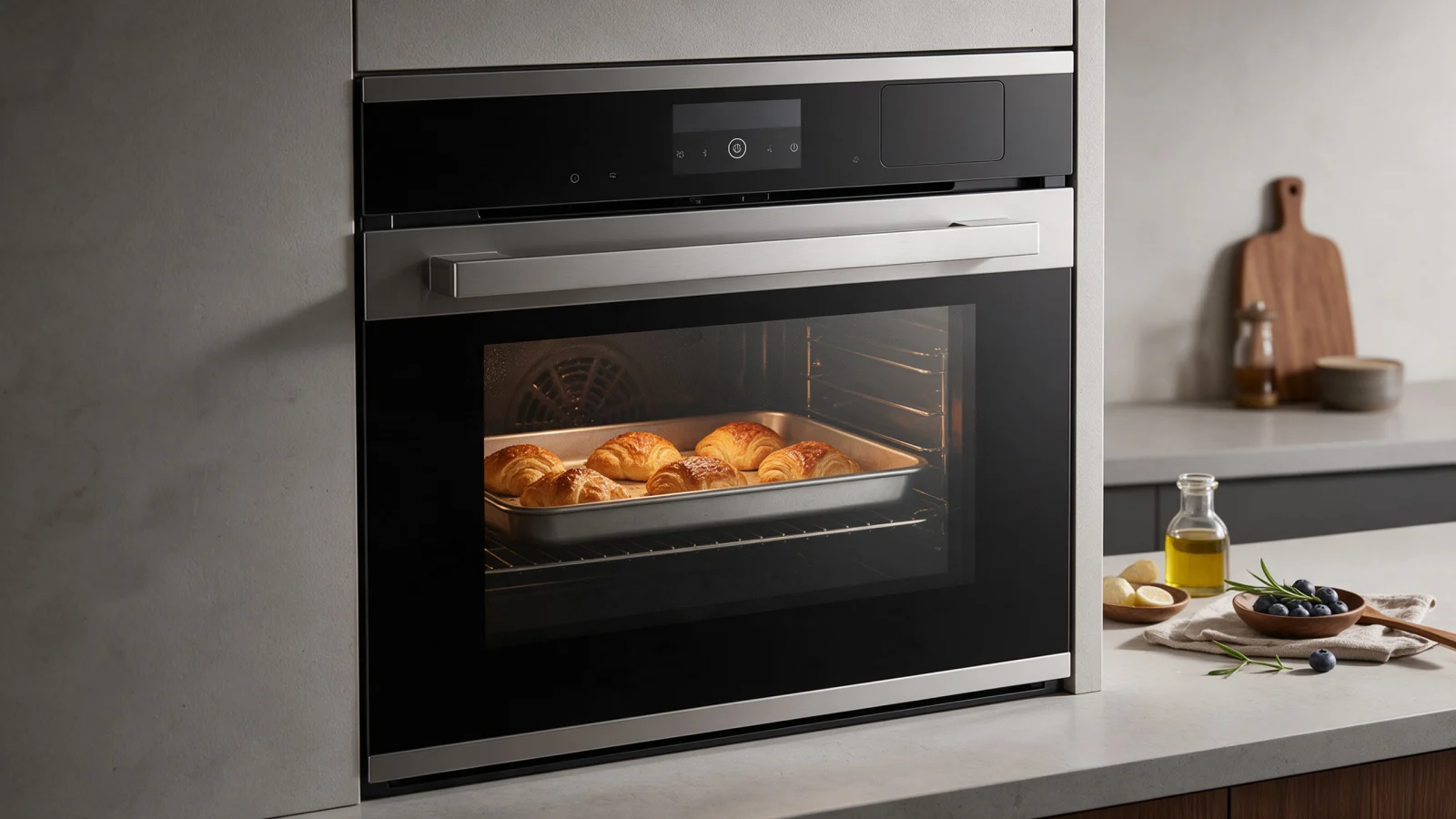
The OB30SDPTB1, a Series 9 Minimal 30-inch oven, is listed with three sets of full-extension sliding shelves, and each shelf position puts food closer to or farther from the heat source. Baking on the top shelf browns the top faster, and baking on the bottom shelf favors the base. For an even result, use the middle position, with a gap between the tray and the oven walls so air can circulate.
With a 17-function oven you can choose among several ways to heat the cavity, and the right one for a tray of biscuits differs from the right one for a roast. The RDV2-366-N_N dual fuel range lists six oven functions, and the OB30SDPTB1 lists 17 functions and guided touchscreen cooking. If you have changed function lately, or the oven is picking a default, go back to the setting you used when results were good. Make sure you also let the oven finish preheating before the food goes in, since a half-preheated oven bakes the bottom first.
Heat leaking from a Fisher & Paykel door edge will cool one side of the cavity. Look at the door seal for gaps, flattened sections or baked-on spills, and check the door sits level and closes firmly. A door that does not shut square can explain a cold stripe along one edge. Opening the door repeatedly to look at the food drops the temperature and unbalances the bake, so use the oven light.
A2 and A3 are listed as door lock errors around a Self Clean cycle, with a check of turning power off and on and resetting the clock. If a door lock error occurred just before the uneven baking started, mention it. F1XX is listed as a clock board fault and F2XX as a power board fault, and either can disturb how the oven controls its heating. For the F-codes we document, see oven F443 and oven F442; match digits exactly before reading anything into them.
A tray test with a sensible shelf and function can settle most uneven bakes. It cannot prove that the heating elements are balanced, that the convection fan is turning at the right speed, that the temperature sensor is accurate, or that the oven holds its setting. A separate oven thermometer can show a gap between the display and the cavity, but it tells you nothing about where the gap comes from. Do not try to adjust a sensor or reach the fan, and do not rely on a calibration offset as a repair. See the other model pages we keep, such as the OB30SD17PLX1 oven and the OB30DDPTDX1 double oven, if you need to confirm yours.
Send us your Fisher & Paykel model and serial number, your photos of the bake, the shelf, function and temperature you used, how long it has been uneven and whether it ever baked well. A technician will check each element, the fan, the sensor and the door seal. Details are on our oven repair page.
Try the middle shelf, leave space around the tray, turn it halfway, and check that the function is the one you normally use. If the back still runs hot, it needs a technician.
Yes. A tray that does not sit flat holds food at uneven heights, so use a flat tray when testing.
Not as a first step. An offset hides a symptom without telling you whether something has failed, so test with a thermometer and report it.
Share a few details and we’ll confirm an appointment. Prefer to talk? Call us and we’ll help right away.