

Specialized Fisher & Paykel Appliance Repair in San Francisco
Mon–Sat: 8:00 AM – 7:00 PM
A Fisher & Paykel DishDrawer that will not close is often blocked by the load, the runners or the seal. Check these before you suspect the lid or controller.
Written for Fisher & Paykel owners
A Fisher & Paykel DishDrawer that will not close properly is most often blocked by something in the load, a tall item catching the drawer above or behind it, or a runner that is out of line. Pull the drawer out fully, look for the obstruction, and check that it rolls freely before you suspect the lid or the electronics.
A drawer that stops a hand’s width short is usually blocked. A drawer that closes but bounces back out has either caught on something at the rear or does not sit properly on its runners. A drawer that shuts but the cycle will not begin is a different kind of fault, and it comes with the lid or the controller. Work out which of these you have before you start moving things.
The DD24SAX9N single drawer is listed with a maximum plate diameter of 11 1/2 inches and a height of 16 1/8 inches. A platter, a baking tray or a tall pot that goes beyond what the basket was designed for can ride against the drawer front or the rear and stop the drawer from closing. The Contemporary tall double DD24DT4DX2 holds 14 place settings across two drawers, and each drawer is operated on its own, so check the drawer that will not shut, not just the one you last used.
On a Fisher & Paykel double drawer, remove the top rack items first, then the lower basket. Pay attention to long utensils that point upward and to the cutlery basket; a spoon standing above the basket edge can catch the top of the drawer opening. Redistribute the load and try again.
The DD24DTX6HI1 is listed with soft-close drawers. A soft-close mechanism slows the final inch, so a drawer that feels sticky near the end may be a damper, not a blockage. Push gently and watch whether it settles. If it halts, spring back or tilts to one side, the runner on that side may be out of line or have debris on it.
Look along the sides for dropped utensils, a loose label or a tablet wrapper that fell down the side. Check the seal around the tub opening for folds or damage. A folded seal can hold the drawer a little open, and then the lid sensing reports that the drawer is not fully shut.
The older E-code list for the DishDrawer gives E5 as a fault with the internal lid of the dishwasher, and EC as an electronics fault in communication between drawers. On a double drawer model, the two drawers talk to each other, and a fault there can show up as one drawer refusing to start. This site has pages for E5 and EC with the matching reading. A newer FC page covers the next generation of codes.
| Code | Meaning as listed | What to check first |
|---|---|---|
| E5 | Fault with the internal lid | Drawer fully closed, nothing under the lid |
| EC | Communication between drawers | Does only one drawer fail? |
| E9 | Controller electronics fault | Note it and call us |
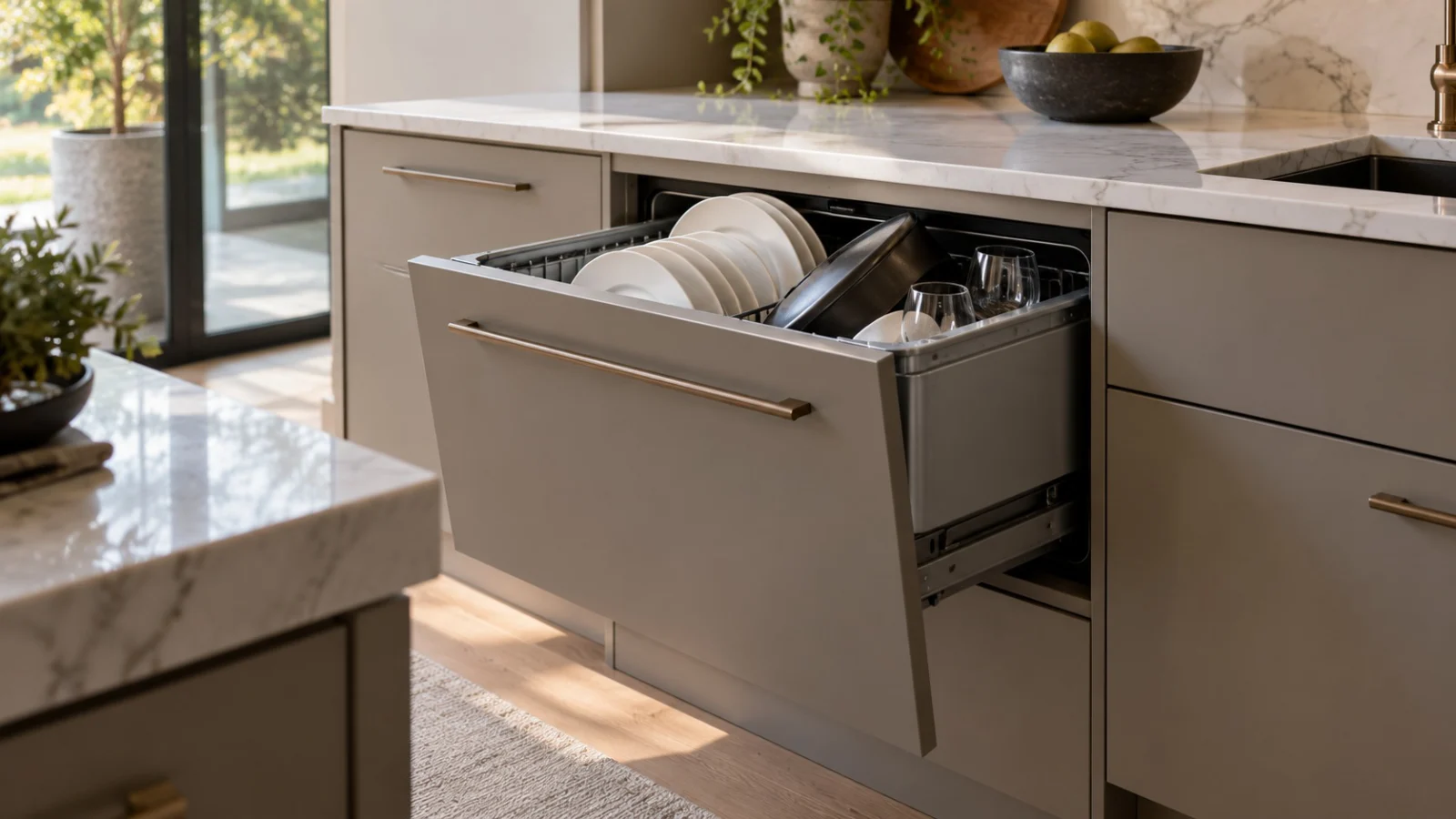
On a Fisher & Paykel unit, pull the drawer out fully and look at how it hangs. A drawer front that sits crooked against the cabinet panel is a clue: the runner on the low side may have dropped, or the drawer has been lifted off its track and refitted slightly out of line. Check the gap between the drawer front and the surrounding panels, and see whether it is the same on both sides. In a panel-ready model such as the DD24DT4I2, listed with a panel-ready design, a heavy custom panel can change how the drawer sits, so mention that panel when you call.
These checks cannot show whether a runner is damaged, a hinge pin is worn, or the lid switch is faulty. A technician tests the drawer travel, the lid sensing and the communication between drawers. Through DishDrawer repair, please give us the model and serial from the rating label, which drawer is affected, any code, and when it began. Our dishwasher reference lists nearby symptoms.
Each drawer on a double model operates on its own, so a load, a runner or a seal fault on one side does not affect the other.
Not on a soft-close model, where the slowing is designed. A drawer that stops, tilts or springs back is different.
Do not run a cycle if you had to force it. If the lid sensor reports an open drawer, the cycle will not begin, and forcing the drawer risks damage.
Share a few details and we’ll confirm an appointment. Prefer to talk? Call us and we’ll help right away.