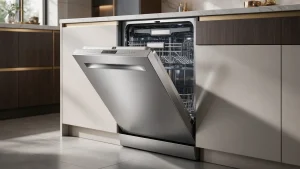
Dishwasher
A dishwasher complaint is most useful when it is described as an operating condition rather than a guessed failed part.

Specialized Fisher & Paykel Appliance Repair in San Francisco
Mon–Sat: 8:00 AM – 7:00 PM
This reference helps organize useful information before dishwasher service. Start with the complete model or product code and the actual behavior you observe; avoid choosing a part from the symptom alone.
Dishwasher · in-home diagnosis
This reference helps organize useful information before dishwasher service. Start with the complete model or product code and the actual behavior you observe; avoid choosing a part from the symptom alone. A dishwasher fills, washes, and drains in separate stages handled by different parts, so naming the stage where the problem appears narrows the search more than describing the final result.
Fisher & Paykel appliances can differ substantially across product generations. Exact identity is especially important when a family name covers multiple control systems, sizes, installation types, or regional variants.
For each symptom, note whether it is constant or intermittent, what operating stage triggers it, and what changed immediately before it began. A clear timeline is often more useful than a broad description such as “not working.” For a leak, say whether water first shows at the door edge or at the base, because the door seal and the connections underneath are different areas.
Locate the rating label and record the full model/product code, including meaningful letters or suffixes. Use the Fisher & Paykel model directory to match that identity to the correct reference material.
Do not substitute a nearby model because the exterior looks similar. Control logic, components, wiring, plumbing, venting, and fault definitions can differ even within the same appliance category.
Stop using the appliance for smoke, burning odor, visible arcing, repeated breaker trips, uncontrolled heating, active water near electrical parts, gas odor, or severe movement. Do not remove protected panels, work on live voltage, adjust gas components, bypass safety devices, or open sealed refrigeration systems as an owner check.
A built-in or tightly fitted appliance interacts with cabinetry, ventilation space, drain routing, water supply, electrical connection, floor level, and door or drawer alignment. If a symptom appeared after remodeling, moving the appliance, replacing a filter, changing plumbing, or restoring power, include that history.
San Francisco housing adds practical access variables as well. Older flats can have narrow stairs and compact kitchens, while newer towers may require concierge entry, elevator reservations, or loading coordination. Those details help plan the visit without changing the technical diagnosis.
If the appliance shows a code, use the Fisher & Paykel error-code library and match the code to the correct appliance family and model/platform context. The same short code can be reused with a different meaning elsewhere in the product line.
Treat a code as evidence that narrows testing. It does not automatically prove that a specific component should be replaced. Whether a code repeats on the next cycle or disappears is worth reporting, since a one-time display and a recurring one are different situations.
It identifies the appliance platform more reliably than appearance or a family name and helps keep diagnostic information tied to the correct control generation.
No. A code is a diagnostic clue whose meaning depends on the correct appliance and model context.
Avoid protected-panel removal, live electrical testing, gas adjustment, sealed-system work, interlock bypass, and technician-only service procedures.
A dishwasher complaint is most useful when it is described as an operating condition rather than a guessed failed part.
A20 means the dishwasher is not draining; the listed causes are clogged filters or a blocked drain.
Fisher & Paykel DW24U2I1 integrated dishwasher repair in San Francisco: water left in the tub after the cycle, dishes not getting clean…
Fisher & Paykel DW24UT2I2 integrated dishwasher repair in San Francisco: leak or leak-protection code, cycle stops early or will not start.
Drop-door dishwasher — repair reference for drainage and cleaning faults.
Fisher & Paykel GW501 smart drive top-loading washing machine repair in San Francisco: cycle stuck or error code on the display, leaking…
Fisher & Paykel GW601 smart drive top-loading washing machine repair in San Francisco: leaking during the wash, loud noise or shaking on…
Fisher & Paykel GW701 smart drive top-loading washing machine repair in San Francisco: leaking during the wash, cycle stuck or error code…
This reference helps organize useful information before dryer service.
This reference helps organize useful information before fabric care cabinet service.
This reference helps organize useful information before freezer service.
This reference helps organize useful information before oven service.
Share a few details and we’ll confirm an appointment. Prefer to talk? Call us and we’ll help right away.