

Specialized Fisher & Paykel Appliance Repair in San Francisco
Mon–Sat: 8:00 AM – 7:00 PM
Wet dishes from a Fisher & Paykel DishDrawer point to the cycle, loading, rinse aid or the drying fan and heater. See what to check first.
Written for Fisher & Paykel owners
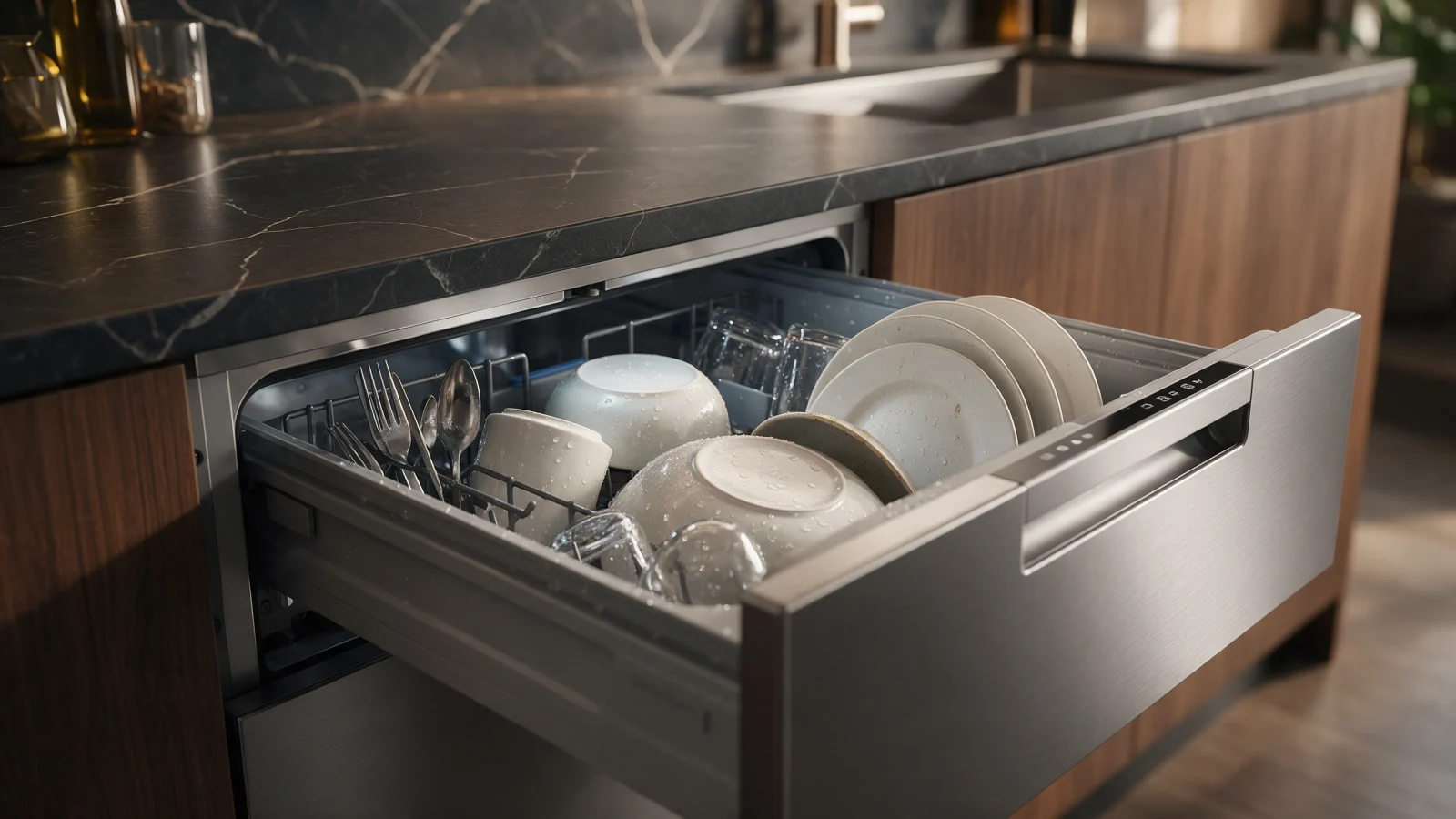
Dishes that come out wet from a Fisher & Paykel DishDrawer usually mean the drying stage did not run fully, the load trapped water, or the rinse was too cool. Check the cycle you chose and how the dishes sit before you suspect the drying fan or the heater.
Some wetness is expected. Plastics hold less heat than china or glass, so droplets on a plastic container after a cycle are normal. If everything is wet, including ceramic and glass, the drying stage failed or was cut short. If only cups and bowls with an upward-facing base hold pools, the problem is how they were loaded. Decide which pattern you have before you change anything.
The Series 9 DD24DT4I2 is listed with fan-assisted drying. Fan-assisted drying moves air through the tub after the hot rinse, so a fan fault leaves condensation behind. The older E-code list gives E6 as a fault with the drying fan and E4 as a failed heating element. A drawer that rinses cold and cannot warm its dishes will always leave water on them, and a fan that does not turn leaves moist air in the tub.
On a different design, the 60 cm DW60FC2B2 is listed with an Auto Door Open Dry that releases steam after washing. That is not a DishDrawer feature, but the principle is similar: the machine relies on residual heat. Cutting a cycle short, or choosing a quick program, reduces the heat available.
A short or cold program gives little heat to dry with. Try a longer wash with a hot final rinse and compare. Check the rinse aid level if your drawer uses one: without it, water forms beads and runs back down instead of sheeting off. Then think about loading: cups tilted slightly, bowls facing down and flat items kept apart all let water drain away. Nesting bowls, or packing plates into a tight stack, traps moisture.
The single DD24SAX9N is listed with a supply voltage of 120 V at 60 Hz. That is mains power, so a suspected heating or fan fault is a job for a technician, not a case for opening the unit yourself.
Drying is the slowest part of the cycle, and it is easy to judge too early. Check the dishes once the cycle has finished and the display has gone quiet, not while it is still showing a drying stage. Take note of whether the upper drawer and the lower drawer of a Fisher & Paykel double behave the same. If the upper drawer dries well and the lower does not, the loading in the lower drawer or one drawer’s fan is more likely than a general fault. A Fisher & Paykel drawer that dried well until recently and now leaves water points to a component that has changed, not to a habit.
Also think about what changed around the time the problem started: a new detergent or rinse aid brand, a different cycle, a plumbing job that affected the hot supply, or a power cut. These details shorten the diagnosis.
If your drawer displayed an E-code during or after a cycle, note it. E3 is given as a temperature sensor fault with incoming water that should be below 65 C (149 F), which means the machine was not reading temperature correctly. E6 is the drying fan, and E4 is the heating element. See the E6 page and the E4 page on this site, and the F83 page for the newer reading.
| Code | Meaning as listed | What you might notice |
|---|---|---|
| E3 | Temperature sensor fault | Dishes cool or cycle stops |
| E4 | Heating element failed | Water never gets hot |
| E6 | Fault with the drying fan | Moist tub, wet dishes |
These cannot show whether the fan turns, whether the heating element draws power, or whether the temperature sensor reads correctly. A technician tests each. Book through DishDrawer repair and tell us the model and serial from the rating label, the cycle you used, which drawer, any code, and whether the dishes are cool or warm when you open it. The dishwasher reference lists related causes for a Fisher & Paykel machine.
Yes. Plastics hold little heat and dry slowly. Wet china and glass point to a drying or heating issue.
It can. Opening the drawer releases the hot air the dishes use to dry. Wait for the cycle to finish.
Yes. E6 is listed as a drying fan fault, which leaves moisture in the tub.
Share a few details and we’ll confirm an appointment. Prefer to talk? Call us and we’ll help right away.