

Specialized Fisher & Paykel Appliance Repair in San Francisco
Mon–Sat: 8:00 AM – 7:00 PM
Food or film left on dishes by a Fisher & Paykel DishDrawer points to the filter, spray arm, load or water. Check these first.
Written for Fisher & Paykel owners
Food or a cloudy film left on dishes by a Fisher & Paykel DishDrawer usually comes from a blocked filter, a spray arm that cannot turn, or a load that shields the water. Hard water and detergent also leave film. Check the filter and spray arm, then look at how the drawer is loaded.
Soil that is still stuck on in patches means water did not reach it or the filter fed grit back into the wash. A white film that wipes off with a damp cloth is usually hard-water scale or undissolved detergent. Greasy streaks on glass and plastic suggest low wash temperature or too little detergent for the soil. A cloudy glass that does not clean at all can be etching, which is permanent and not a fault in the machine. Work out which of these you have by wiping a dish and comparing a rinsed one.
On a Fisher & Paykel DishDrawer the filter catches food during the wash, and one that is packed with debris sends dirty water back over the dishes. Take the filter out following the manual for your model, rinse it and refit it fully. Then check that the spray arm spins freely by hand and that its jets are not blocked by seeds or label scraps. The older code list gives U6 as a spray arm that has loosened or come off its mounting, or water pressure that is too low, and U1 as no water because the supply has not been turned on. If either of these appeared, check the arm and the tap before anything else.
Look at the water inlet screen and the supply tap too. On a Fisher & Paykel machine, low flow gives a weak wash even without a code.
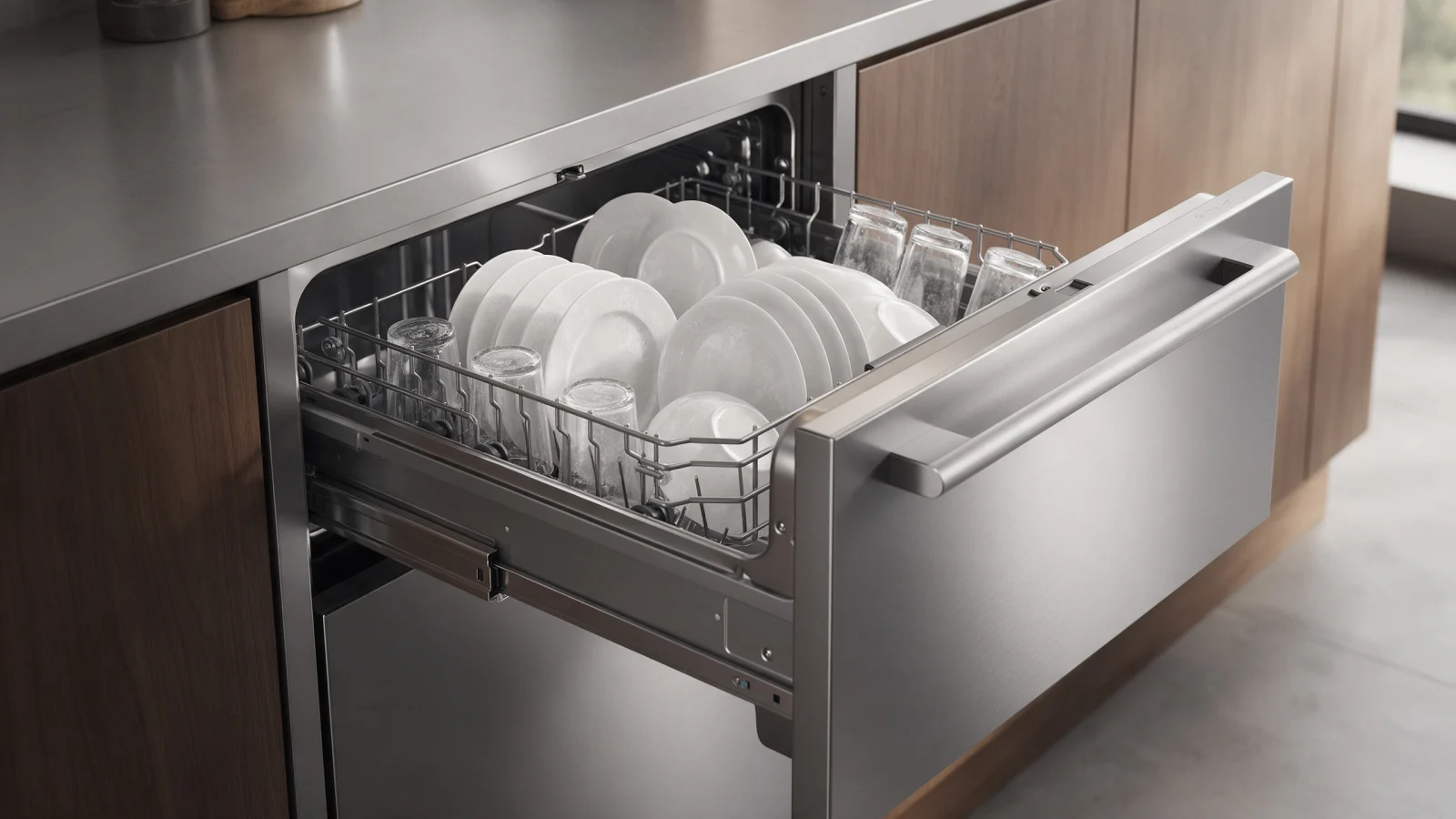
The Professional Series 9 DD24DT4PX2 holds 14 place settings across two drawers, and the single DD24SAX9N holds seven place settings, with plates up to 11 1/2 inches. Those capacities describe a sensible load, not a packed one. Plates that overlap, bowls stacked inside each other and a cutlery basket jammed full leave spots the spray cannot reach. Face the dirtiest surfaces towards the centre, and keep large items from blocking the arm’s path.
A tall double lets you run the lower drawer alone. If one drawer cleans well and the other does not, compare the filters and spray arms of the two.
Many owners rinse plates heavily before loading, which can leave the detergent with nothing to work on and produce film. Scrape large scraps off and leave the rest for the wash. Measure the dose as the manual advises, and use the amount that suits the water hardness in your area. Do not mix detergent types in the same drawer, and avoid putting a tablet where it can slip behind a basket. Compare one cycle with fresh detergent and a clean filter against the last one; a Fisher & Paykel drawer that cleans well after those two changes was not faulty.
The E-code list shows several detergent and temperature items. E7 is an electronics fault in the detergent dispensing system, and E3 is a temperature sensor fault, noting that incoming water should be below 65 C (149 F) and that a tempering valve may be needed. E4 is a failed heating element. If detergent is left in the dispenser after a cycle, or dishes feel cool at the end, mention the code and what you saw. The E7 page and E4 page on this site give the longer reading.
| What you see | Possible link | First check |
|---|---|---|
| Gritty food on dishes | Filter or spray arm | Clean filter, spin arm |
| Detergent left in the dispenser | E7 dispensing | Check lid movement, note code |
| Dishes cool and filmy | E3 or E4 area | Check hot-water supply |
| Film that wipes off | Hard water | Check softener, rinse aid |
The DD24DTX6HI1 is listed with a built-in water softener, so on a unit like that, the softener settings and salt or regenerant level in the manual are worth checking if film appears.
These steps cannot show whether the pump delivers enough pressure, whether the heater reaches temperature, or whether the dispenser latch moves. A technician tests those. Through DishDrawer repair, give us the model and serial from the rating label, which drawer, the cycle you use, any code, and a photo of the soiled dishes. The dishwasher reference page lists related causes.
Each drawer has its own filter and spray path, so compare them. A blocked arm or filter on one side explains it.
Often it means hard water or too much or too little detergent. Check the softener and rinse settings first.
E7 is listed as an electronics fault in the detergent dispensing system. If detergent is left in the dispenser, a technician should test it.
Share a few details and we’ll confirm an appointment. Prefer to talk? Call us and we’ll help right away.