Cooktop
A cooktop complaint is most useful when it is described as an operating condition rather than a guessed failed part.

Specialized Fisher & Paykel Appliance Repair in San Francisco
Mon–Sat: 8:00 AM – 7:00 PM
This reference helps organize useful information before cooktop service. Start with the complete model or product code and the actual behavior you observe; avoid choosing a part from the symptom alone.
Cooktop · in-home diagnosis
This reference helps organize useful information before cooktop service. Start with the complete model or product code and the actual behavior you observe; avoid choosing a part from the symptom alone. A gas burner that clicks without lighting and an induction zone that will not detect a pan involve entirely different systems.
Fisher & Paykel appliances can differ substantially across product generations. Exact identity is especially important when a family name covers multiple control systems, sizes, installation types, or regional variants.
For each symptom, note whether it is constant or intermittent, what operating stage triggers it, and what changed immediately before it began. A clear timeline is often more useful than a broad description such as “not working.”
Locate the rating label and record the full model/product code, including meaningful letters or suffixes. Use the Fisher & Paykel model directory to match that identity to the correct reference material.
Do not substitute a nearby model because the exterior looks similar. Control logic, components, wiring, plumbing, venting, and fault definitions can differ even within the same appliance category.
Stop using the appliance for smoke, burning odor, visible arcing, repeated breaker trips, uncontrolled heating, active water near electrical parts, gas odor, or severe movement. Do not remove protected panels, work on live voltage, adjust gas components, bypass safety devices, or open sealed refrigeration systems as an owner check.
A built-in or tightly fitted appliance interacts with cabinetry, ventilation space, drain routing, water supply, electrical connection, floor level, and door or drawer alignment. If a symptom appeared after remodeling, moving the appliance, replacing a filter, changing plumbing, or restoring power, include that history.
San Francisco housing adds practical access variables as well. Older flats can have narrow stairs and compact kitchens, while newer towers may require concierge entry, elevator reservations, or loading coordination. Those details help plan the visit without changing the technical diagnosis.
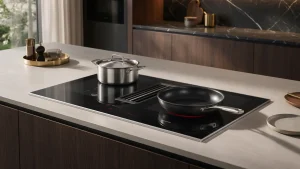
For an induction cooktop, say which pans you used and whether the same pan is detected on another zone, since pan detection depends on the cookware as well as the zone.
If the appliance shows a code, use the Fisher & Paykel error-code library and match the code to the correct appliance family and model/platform context. The same short code can be reused with a different meaning elsewhere in the product line.
Treat a code as evidence that narrows testing. It does not automatically prove that a specific component should be replaced. Testing on the exact model is what confirms whether a zone, igniter circuit, or control is actually at fault.
It identifies the appliance platform more reliably than appearance or a family name and helps keep diagnostic information tied to the correct control generation.
No. A code is a diagnostic clue whose meaning depends on the correct appliance and model context.
Avoid protected-panel removal, live electrical testing, gas adjustment, sealed-system work, interlock bypass, and technician-only service procedures.
A cooktop complaint is most useful when it is described as an operating condition rather than a guessed failed part.
A1 through A7, EX05 and EX01 are listed together as an overheating error on a Fisher & Paykel modular cooktop.
E1 is described as a power supply problem in the owner care guides and as a board or software error in a support article.
Three Fisher & Paykel documents give E2 three different labels: power supply, temperature or power, and sensor error.
E21 is a temperature or power issue on a full-surface induction cooktop, and an electronic board or software error on a freestanding cooker.
E3 means either the cooktop has overheated or the cookware is not induction compatible, depending on the document.
E4 is listed as overheating in the care guides and as an electronic board or software error in support articles.
Fisher & Paykel CDV2-365HN-N five burner natural gas cooktop repair in San Francisco: burner or zone will not heat, igniter keeps clicking.
Fisher & Paykel CDV2-365L-N five burner lpg cooktop repair in San Francisco: touch controls flicker or lock out, burner or zone will…
Fisher & Paykel CDV3-365H-N gas cooktop repair in San Francisco: burner or zone will not heat, touch controls flicker or lock out,…
Fisher & Paykel CE365DTB1 electric cooktop repair in San Francisco: error code on one zone, touch controls flicker or lock out.
Fisher & Paykel CG151DLPGB5 lpg gas-on-glass modular cooktop repair in San Francisco: touch controls flicker or lock out, igniter keeps clicking.
Fisher & Paykel CG151DNGGB5 gas on glass modular cooktop repair in San Francisco: igniter keeps clicking, burner or zone will not heat,…
Fisher & Paykel CG365DLPX1 gas on steel cooktop repair in San Francisco: error code on one zone, burner or zone will not…
36-inch gas cooktop — repair reference for ignition and burner faults.
Fisher & Paykel CI122DTB4 two-zone induction cooktop repair in San Francisco: error code on one zone, touch controls flicker or lock out.
Fisher & Paykel CI244DTB4 induction cooktop repair in San Francisco: cookware not detected (induction), error code on one zone.
Fisher & Paykel CI244ZZDTB5 induction cooktop repair in San Francisco: cookware not detected (induction), touch controls flicker or lock out.
Fisher & Paykel CI304DTB4 four zone induction cooktop repair in San Francisco: cookware not detected (induction), error code on one zone.
36-inch induction cooktop — repair reference for zone and detection faults.
Fisher & Paykel CI365DTTG1 primary modular induction cooktop repair in San Francisco: cookware not detected (induction), error code on one zone.
Fisher & Paykel CI365PTX4 induction cooktop repair in San Francisco: touch controls flicker or lock out, error code on one zone.
Fisher & Paykel CI365ZZDTB5 induction cooktop repair in San Francisco: cookware not detected (induction), error code on one zone.
Fisher & Paykel CIT152DX1 auxiliary teppanyaki cooktop repair in San Francisco: error code on one zone, cookware not detected (induction).
Fisher & Paykel CPV3-366-L lpg gas rangetop repair in San Francisco: touch controls flicker or lock out, igniter keeps clicking, error code…
This reference helps organize useful information before CoolDrawer service.
This reference helps organize useful information before DishDrawer dishwasher service.
This reference helps organize useful information before dishwasher service.
This reference helps organize useful information before dryer service.
Share a few details and we’ll confirm an appointment. Prefer to talk? Call us and we’ll help right away.