

Specialized Fisher & Paykel Appliance Repair in San Francisco
Mon–Sat: 8:00 AM – 7:00 PM
A Fisher & Paykel warming drawer that stays cool often has the wrong function or a drawer that isn't fully latched. Check both before booking.
Written for Fisher & Paykel owners
When a Fisher & Paykel warming drawer does not warm, the cause is most often something about how it is being used, such as the function selected, a drawer that has not fully latched, or a load that is too cold and too large for the setting. Confirm the function and the closure first, then give it enough time with a typical load before deciding that the heating has failed.
These drawers do more than keep plates warm. The WB24SDEX2, a 24-inch Series 9 Contemporary warming drawer, lists six functions including Rapid Proof, Dehydrate and Slow Cook. A drawer left on Dehydrate or Rapid Proof will feel only gently warm compared with a setting meant for holding hot food, and nothing is wrong with it. Before anything else, read the display and confirm the function and temperature you think you set are what the drawer is showing.
It is also worth checking whether a timer ran out. If the drawer was started with a time limit, it can switch itself off, and a drawer that was warm an hour ago and cold now has simply finished its program.
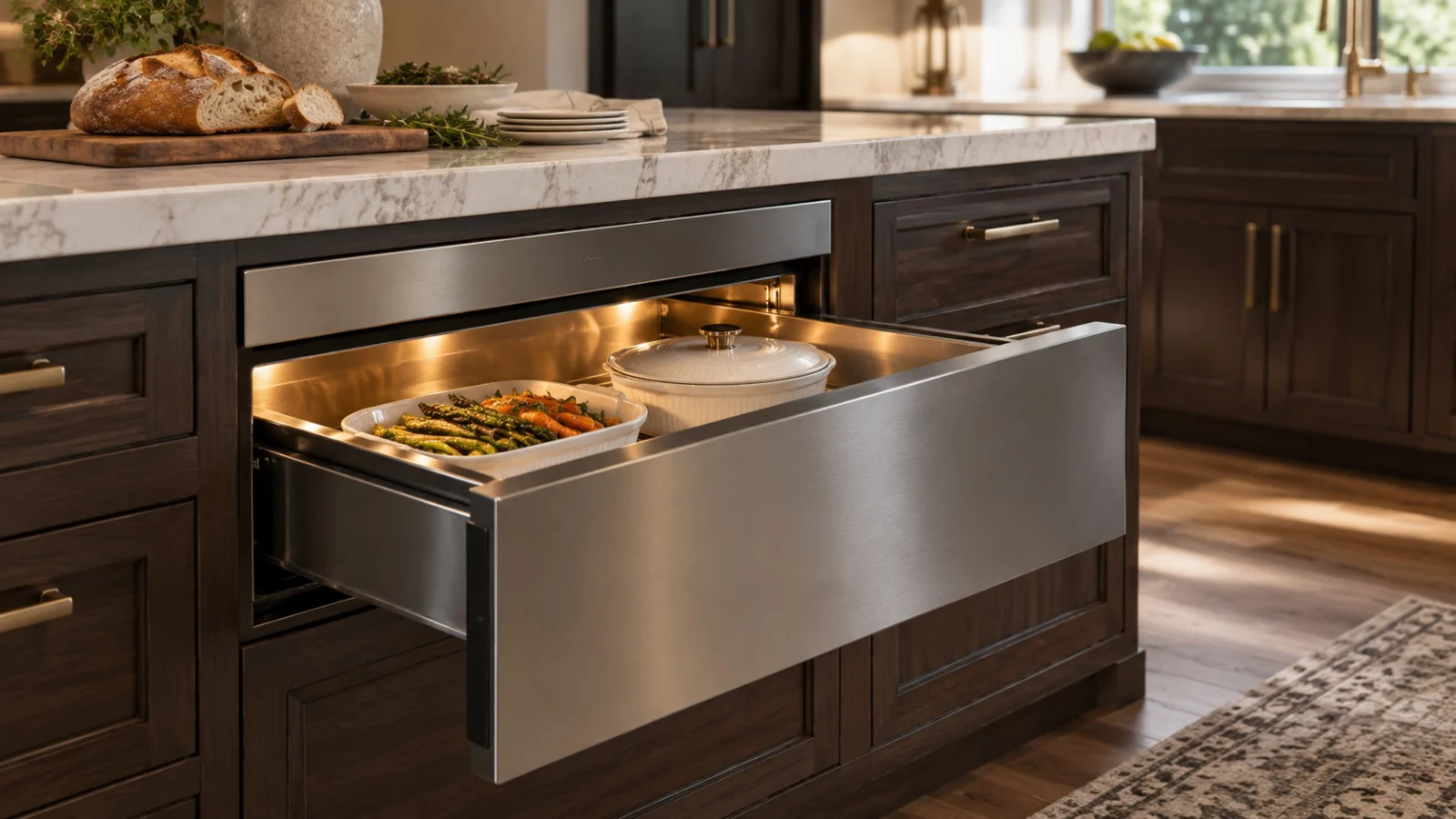
On a Fisher & Paykel drawer, closure matters because the warmth is held inside the cavity. The 24-inch WB24SDEX2 is described with a push-to-open drawer, while the WB30SPEX3, a 30-inch Series 9 Professional drawer, has a soft-close drawer and touch controls. Either style can end up resting a little open if a pan handle, a tea towel or a sheet tray edge sits on the runner. Look along the front edge for an even gap, and slide the drawer in until it takes up the latch by itself.
A Fisher & Paykel drawer sized for place settings is not a quick oven. The 30-inch WB30SPEX3 is listed as holding 16 place settings, and the 24-inch drawer is listed as holding six dinner place settings. A full drawer of cold plates will take longer to feel warm than a half-full one of room-temperature plates, and stacking items tightly limits how well warmth moves around them.
Run a simple test. Empty the drawer, set a function intended for warming, and leave a few plates in it for the time the manual describes. Touch the plates and the drawer floor when you open it. If the plates are warm but your usual load is not, the heating is likely fine and the load is the issue. If nothing becomes warm even when the drawer is nearly empty, that is a different report to make.
Integrated versions need an extra thought. The WB30SDEI1, a Series 9 Integrated warming drawer, is listed at 10 11/16 inches high with capacitive touch controls. On an integrated drawer the front is a panel, so a panel that has shifted, or a cabinet around it that has swollen or been repainted, can change how the drawer closes. Capacitive touch controls can also fail to respond if the glass has a film on it or is wet, and in that case it may look as though the drawer is on when it has not accepted the command.
Wipe the control area dry with a clean soft cloth and try again. A fingertip that is damp or wearing a glove may not register. If the controls respond sluggishly only after cooking nearby, moisture or grease on the glass is a likely reason. You can see the other warming drawer sizes we service in our warming drawer reference, and some have their own pages such as the WB24SDEX2 warming drawer.
Correct function, a clean latch and a sensible load can solve the complaint, and then you are done. They cannot reveal whether the heating element is energizing, whether the temperature sensor reads correctly, or whether the control board is delivering power to the element. A drawer that shows an active setting but stays cold after a fair wait is past what you can check safely. Do not remove the drawer or work behind it, because the area contains mains wiring. Avoid running it empty for long stretches while troubleshooting.
A technician will check the supply to the Fisher & Paykel drawer to the drawer, the function logic, the element and its sensor, and the closure. Tell us the model number from the rating label, the serial number, which function you used, how long you waited, and whether the drawer is a freestanding-style unit or an integrated one behind a panel. Our warming drawer repair page explains the booking process.
That depends on the function, the load and the model, so the manual for your drawer is the right reference. If it stays cold with a light load and a fair wait, report it.
Yes. Functions such as Rapid Proof and Dehydrate are meant for gentle warmth, so they feel much milder than a setting meant for holding cooked food hot.
Moisture, grease or a thin film on the glass can stop a touch control from registering. Wipe it clean and dry and try again with a bare, dry fingertip before calling.
Share a few details and we’ll confirm an appointment. Prefer to talk? Call us and we’ll help right away.